There is a sentence I have heard throughout my life, usually appearing in conversations about the future — when people talk about careers, relationships, dreams, and the lives they hope to build. Someone admits they do not know exactly what they want to do or where life will take them, but then, almost immediately, they say something with complete certainty: “I know I was born to be a mother.”
Every time I hear it, I am struck by the confidence behind those words. Not because I question it, but because I have never experienced that same certainty myself. There is something beautiful about knowing so deeply what you want, about carrying a vision of your future that feels natural and undeniable.
But that has never been my story. I did not grow up imagining motherhood as an inevitable part of my identity. I never had that quiet feeling some people describe — the sense that, above everything else, this was the role they were meant to have. I do not feel an immediate pull when I see children playing, laughing, or running around. I have never looked ahead and felt completely certain that motherhood was waiting for me.
And sometimes, hearing others speak about it so naturally makes me wonder why I do not feel the same. What does it mean when something that feels instinctive to others feels uncertain to you? Does uncertainty mean there is something missing? Does it mean I am disconnected from something that many women seem to experience so naturally?
I am not against motherhood. I am not someone who has decided that children are not part of my future. The truth is much more complicated than that. I am simply unsure — unsure if I want to give my body, my time, my freedom, and the shape of my life to such a profound responsibility. Unsure if motherhood is something I will one day grow into, or something I may never fully desire.
But this question became even more complicated after a conversation where another perspective emerged: the idea that becoming a mother is what makes a woman complete. The belief that without experiencing motherhood, a woman has not lived the full spectrum of what it means to be one. That there is a part of womanhood that remains untouched unless you become responsible for another life.
And that idea stayed with me. Because if motherhood is one of the most meaningful experiences a woman can have, does that mean those who never experience it are somehow missing a fundamental piece of themselves? Does choosing another path make them less complete?
I struggle to believe that it does. Because when I look around, I see countless examples that challenge that idea. I think about my own aunt, and about women I deeply admire — both cultural icons and people I follow online — who have never been mothers and never plan to be. Women who are fulfilled, loved, curious, creative, and deeply connected to the lives they have built.
Some live with partners, some live alone, some create families through friendships and communities, and others dedicate their time to their work, passions, and personal growth. Their lives are not defined by what they did not experience, but by everything they have chosen to create. And I find myself asking: are they not fully women?
Of course they are.
Maybe the problem is not motherhood itself, but the idea that there is only one path toward becoming whole. Motherhood can be a deeply meaningful part of a woman’s life, but perhaps it does not have to be the measure of her femininity, her purpose, or her completeness.
We often talk about the women who dream of having children and the women who consciously decide not to. But we do not talk enough about the women who exist somewhere in between — those who are still asking themselves the question, those who do not know yet, those who are learning to live without an immediate answer.
And maybe that uncertainty deserves more space. Because not having an answer does not mean a person is lost. Sometimes, it means they understand the weight of the decision they are facing. Bringing a life into the world is one of the biggest choices a person can make, and it should come from honesty rather than expectation.
Perhaps the people who know they want children are not more complete because they have certainty. And perhaps those who are unsure are not lacking anything because they are still searching. Maybe there is no single way to experience womanhood, and maybe becoming yourself does not have to follow a predetermined path.
I do not know what I will choose. Maybe one day I will meet someone and something will shift. Maybe I will not simply want children — maybe I will want to build a family with that person in a way I cannot imagine today. Or maybe I will not.
And maybe that will be okay too.
Because I do not need to force an answer before I have one. Not knowing does not make me less of a woman. It simply means I am still becoming.
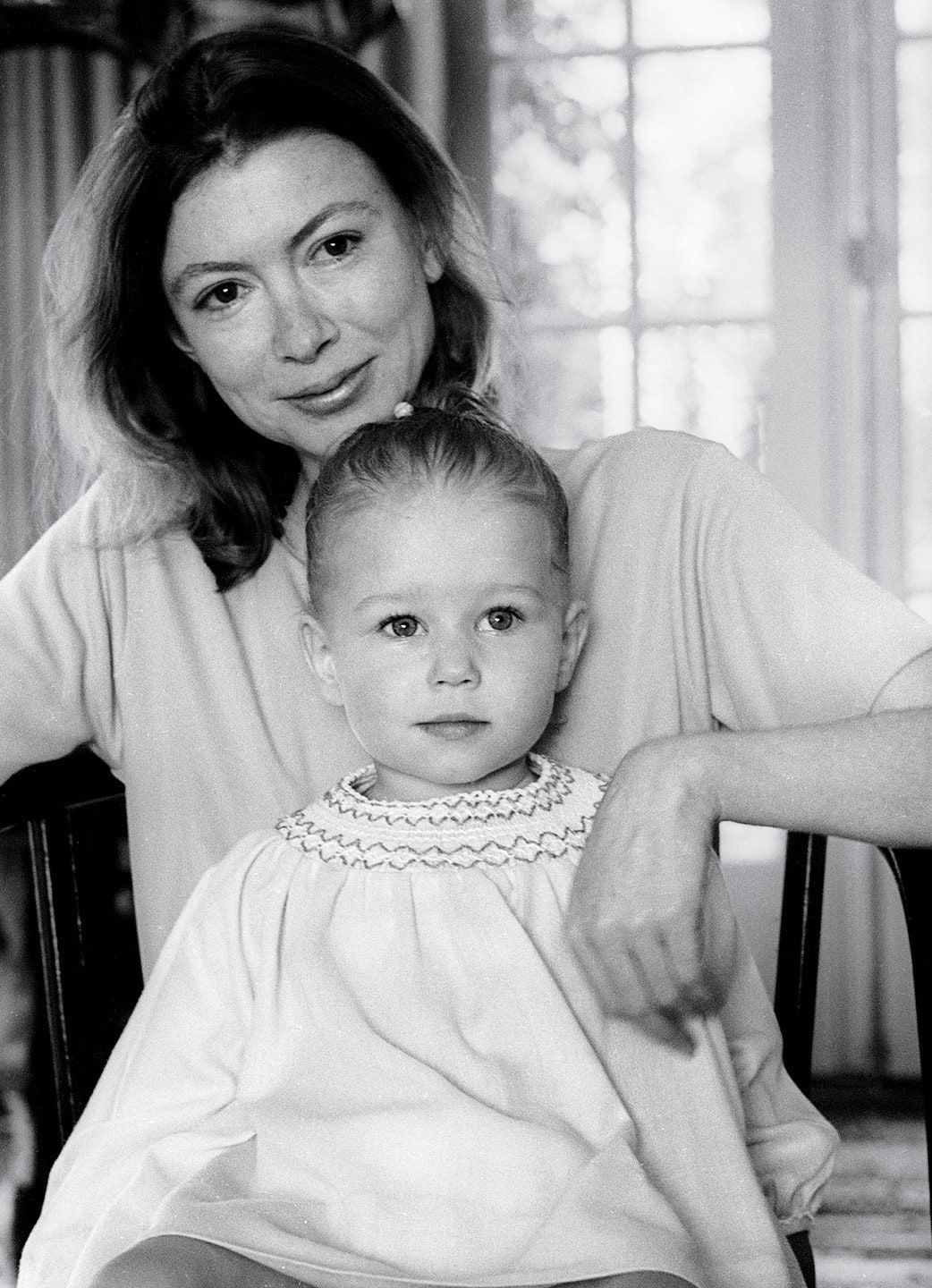
Image credit: Julian Wasser; “Joan Didion with Quintana”, 1968